
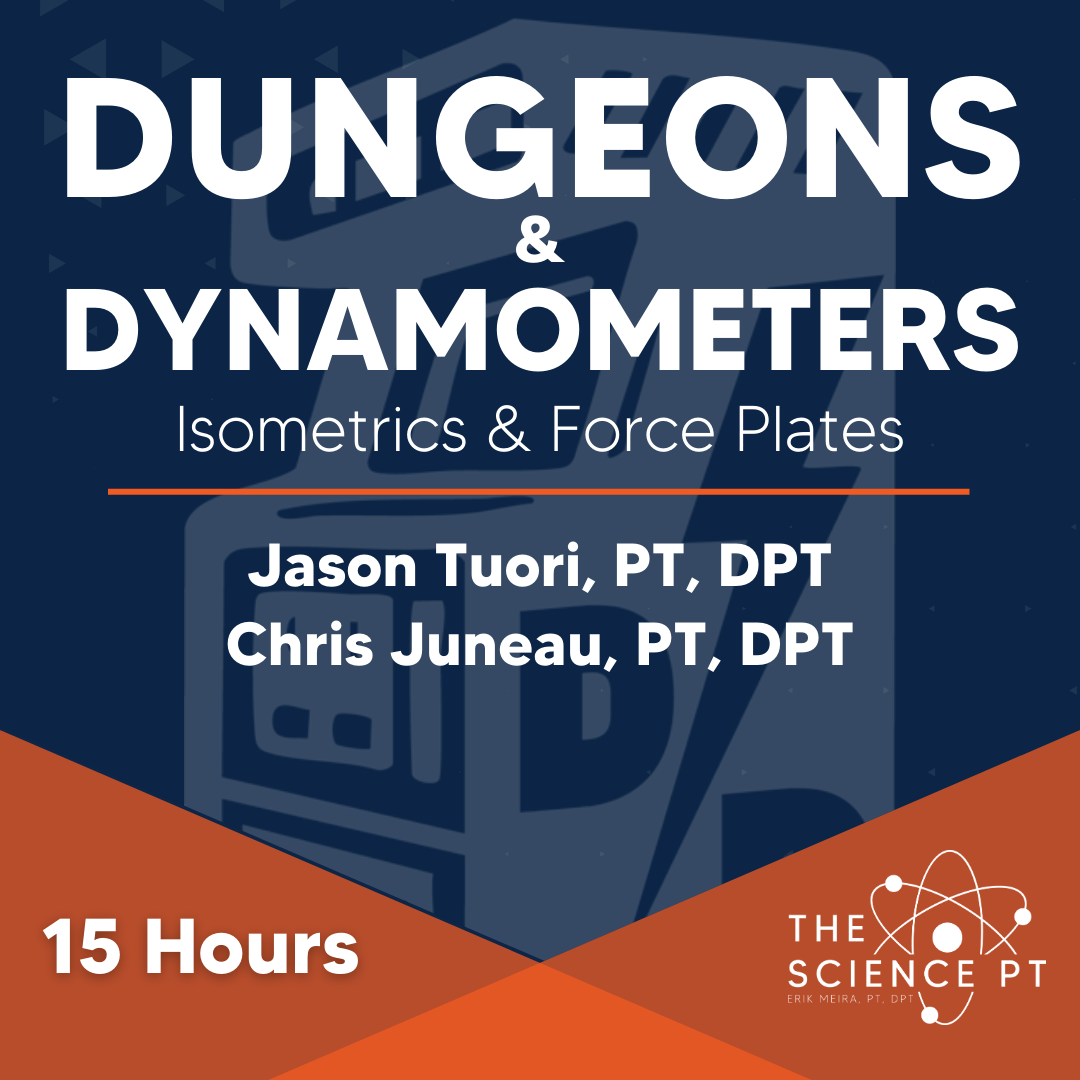
Dungeons and Dynamometers: Isometrics & Force Plates
By Jason Tuori, & Chris Juneau
Currently Scheduled Dates
Atlanta, GA – June 13-14, 2026
Overtime Elite
Registration Open
Intended Audience:
Physical Therapists, Physical Therapist Assistants, Athletic Trainers, Strength and Conditioning Coaches, and related professions/students of those fields
Description:
Objective testing has taken the physical medicine domain by storm, prompting clinicians to explore more deliberate testing strategies in order to better test, track, and compare client outcomes. At the core of this initiative was a graduation from subjective “strength” testing, commonly seen as manual muscle testing, into more organized force testing areas, like dynamometry. While this agenda was a necessary and important component to evolve the profession, it unintentionally created a dilemma and challenge for clinicians in the field seeing clients. “How can I collect objective data using a dynamometer within my budget of time, resource, cost, and current understanding?” Thus, “Dungeons and Dynamometers: A Force Course” was created.
This 15.0-hour course is designed and organized with practitioners in mind. It will systematically build a narrative around force testing; specifically the why, how, and when one should use it. Finally, it will culminate with allocated time to practice, explore, and troubleshoot integrating force testing into practice immediately. The goal is to demystify the process and make this modality usable and pragmatic through practical cases and sandbox-style lab-based learning. Improving these concepts will not only improve clients’ experiences and outcomes, but it will continue to progress the profession towards more objective interventions.
As the field shifts from subjective assessments to more objective, data-driven evaluations, force plates have emerged as a key tool for quantifying performance, asymmetries, readiness, and rehabilitation progress. Yet, clinicians often face challenges incorporating this technology due to barriers in time, resources, and training. This course bridges that gap by providing a practical, case-based introduction to force plate testing, emphasizing real-world application, clinical relevance, and structured workflows. This includes lecture and lab demonstrations to explore the nuances of data collection, dynamometry, set-up, execution, troubleshooting, and interpretation. Designed to be interactive and exploratory, participants will gain experience through sandbox-style learning with various case studies and guided technical repetitions.
Objectives:
Upon completion of this course, participants will be able to:
- Describe the principles behind data collection using force testing
- Identify the key components of a valid and reliable test using handheld and in-line dynamometry
- Select the appropriate testing parameters for force testing around the hip, knee, ankle, and shoulder
- Develop a systematic approach to using dynamometry that reduces the risk of common user-related errors
- Analyze data collected from force testing with respect to the individual and normative data relevant to that test
- Describe the principles behind ground reaction force data collection using force plates
- Identify the components of valid and reliable testing across jump, isometric, and balance assessments
- Select appropriate force plate protocols based on clinical goals for the lower and upper extremities
- Develop systematic testing procedures to reduce user error and enhance repeatability
- Integrate test results into clinical reasoning and treatment planning for rehabilitation and performance optimization
Schedule
Day 1 |
|
| 08:00 - 08:45 | Dynamometer Overview |
| 08:45 - 10:00 | Knee Extension Testing Demonstration |
| 10:00 - 10:15 | Break |
| 10:15 - 10:45 | Biomechanics 101 |
| 10:45 - 11:45 | Shoulder Testing Demonstration |
| 11:45 - 12:15 | Checklist for Proper Setup |
| 12:15 - 13:00 | Hip Testing Demonstration |
| 13:00 - 13:30 | Lunch (on your own) |
| 13:30 - 14:00 | Recommended Testing Positions |
| 14:00 - 14:45 | Ankle Testing Demonstration |
| 14:45 - 15:30 | Knee Flexion Testing Demonstration |
| 15:30 - 15:45 | Break |
| 15:45 - 16:45 | Fixed Frame Systems |
| 16:45 - 17:00 | Normative Data |
| 17:00 - 17:30 | Speed Labs |
Day 2 |
|
| 08:00 - 08:30 | Background & Force-Time Curves |
| 08:30 - 09:45 | Multi-Joint Isometrics Using Force Plates (Lecture & Demonstration) |
| 09:45 - 10:00 | Break |
| 10:00 - 12:00 | Counter-Movement Jump (CMJ) Sandbox |
| 12:00 - 12:30 | Lunch (on your own) |
| 12:30 - 13:45 | Single Leg CMJ & CMJ Metrics (Lecture & Demonstration) |
| 13:45 - 15:00 | Reactive Jumps & Metrics (Lecture & Demonstration) |
| 15:00 - 15:15 | Final Boss – Review, Q&A, Wrap-up |
Presenters:

Chris Juneau is a sports physical therapist and performance coach with residency and fellowship training in sports physical therapy and biomechanics. He earned his Doctor of Physical Therapy from the University of St. Augustine and a Master of Philosophy in Rehabilitation Science and Biomechanics from Auckland University of Technology, and is a Board-Certified Sports Clinical Specialist with additional certifications in strength and conditioning and performance science. Chris currently serves as Director of Operations for Next Stage Performance and is Co-Founder of Dungeons and Dynamometers, where he focuses on force testing, data analytics, and performance optimization for tactical and performing arts populations. He has worked with U.S. military special operations, performing artists, and Olympic weightlifters, and his clinical interests include hip and spine care, load monitoring, and strength testing strategies.
Jason Tuori is a sports physical therapist and performance coach based out of Atlanta, GA. He currently works as the head physical therapist for Overtime Elite, a basketball academy in Atlanta, GA. Jason is a Board Certified Sports Clinical Specialist and completed residency training at the University of Rochester Medical Center. He received his Doctor of Physical Therapy from SUNY Upstate Medical University and has practiced in various outpatient orthopedics/sports settings. Jason is an NSCA Certified Performance and Sport Scientist and Strength and Conditioning Specialist and formerly worked as the sports performance coach for Rochester New York FC in the MLS Next Pro league, where his responsibilities included both strength and conditioning and sports science roles. Additionally, he served as the physical therapist and sports scientist for the Rochester Jr. Americans in the NAHL junior hockey league during his time at MANA Performance Therapy. Clinically, Jason’s interests are in the management of hip, ankle, and overuse injuries.
Contact Hours 15.0/CEU 1.5
This course meets the standards for 15.0 hours of continuing education by most other state physical therapy boards.
The Science PT (BOC AP#: P3211) is approved by the Board of Certification, Inc. to provide continuing education to Athletic Trainers. This program is eligible for a maximum of 15 Category A hours/CEUs. ATs should claim only those hours actually spent in the educational program.
The Science PT is recognized by the New York State Education Department’s State Board for Physical Therapy as an approved provider of physical therapy and physical therapist assistant continuing education.
For more information on CEU, check out our Continuing Education Credit page.
Terms & Conditions/Refund Policy
By registering for this course you agree to the Terms & Conditions including the refund policy.
Currently Scheduled Dates
Atlanta, GA – June 13-14, 2026
Overtime Elite
Registration Open